
Why Christchurch's Glass Problem Is Bigger Than a Fourth Bin
Christchurch City Council is currently weighing public feedback on a proposal we've been championing for years: adding a dedicated kerbside bin just for glass. Christchurch and Auckland are the last two major centres in New Zealand still relying on mixed recycling bins instead of separate glass collection, and it's a gap our CEO Chris Grant has been pushing to close for the past seven years.
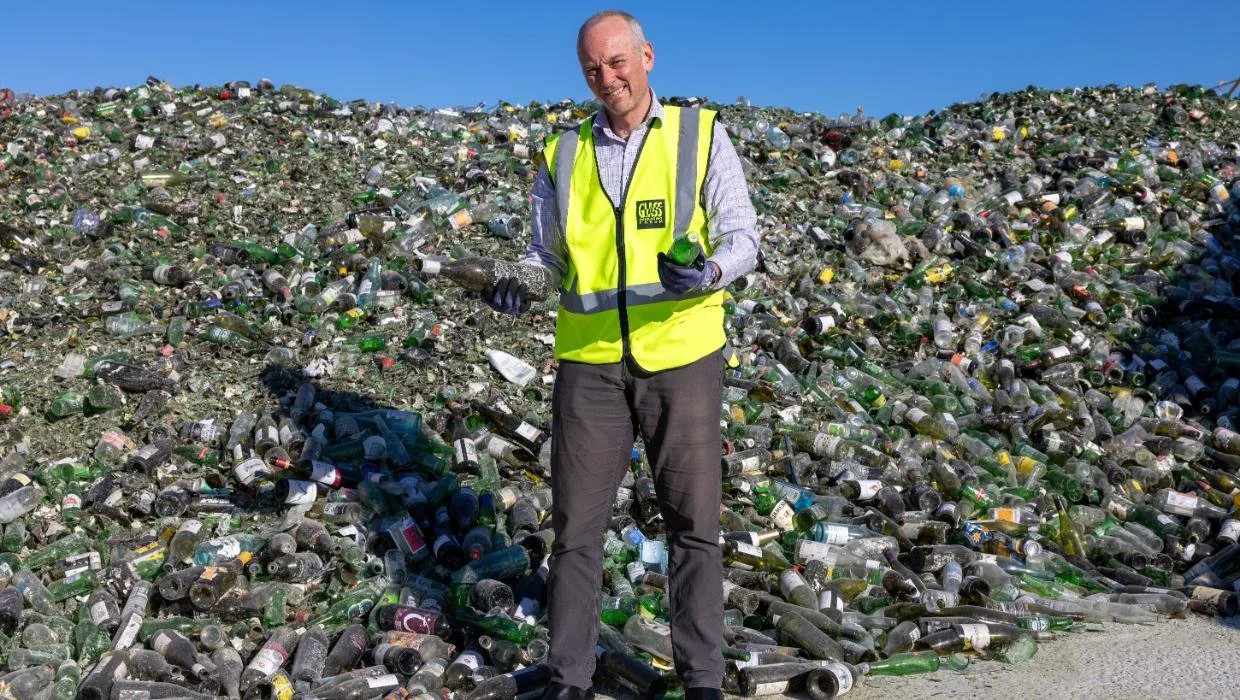
Chris Grant joined RNZ's Morning Report this week to talk about the case for better glass separation, what actually happens to the glass we recover, and why he thinks New Zealand's Container Return Scheme is solving the wrong problem. Listen to the interview here.
Diverting glass from landfill
5R Solutions began in flat glass recovery and now runs 18 regional facilities alongside two processing centres nationwide. Our philosophy is simple: glass shouldn't be going to landfill in the first place.
"It's our job to come up with innovative ideas to get that glass out of landfill," Chris said. On the flat glass side specifically, he estimates we're now diverting roughly 80 to 90 percent of material that would otherwise be buried.
Flat glass, think windows and windscreens, behaves differently to bottle and jar glass. Double glazed units bring extra components that need to be stripped out, while laminated glass contains a plastic interlayer that has to be separated before the glass can be reprocessed.
More than just bottles and windows
Once recovered, glass has a wide range of second lives. We feed processed flat glass into two furnaces, one producing Pink® Batts® insulation, the other making packaging glass. Beyond that, recovered glass is used in filtration systems, effluent management, and as an additive in paint and industrial coatings.
Chris is especially animated about one particular use: Sports Turf. In 2011, ahead of the Rugby World Cup, 5R Solutions worked with the New Zealand Sports Turf Institute to lay a glass sand carpet under a sports field in Nelson, a world first, using crushed glass in place of natural sand as the base layer for the grass to grow through.
The case for a fourth bin
Christchurch's proposed glass bin comes with an estimated ratepayer cost of $65 to $75 a year. Chris is sceptical the real figure will land anywhere near that, "not if the right system's put in place," he says, but he's unequivocal about the environmental case.

Removing glass from the yellow bin doesn't just mean more glass gets properly recycled. It also improves outcomes for everything else in that bin, since glass contamination degrades the quality of paper, cardboard and plastics collected alongside it.
"Having glass out is a two-fold effect," Chris explained. "Glass going back to furnace has a huge environmental benefit, and all the other recyclables left in have a better life in the process."
Learning from source separation overseas
Chris points to countries with more granular household sorting systems as a benchmark. Some regions of Japan separate up to seven or eight material streams at the kerb, and much of Europe follows a similar model.
Interestingly, he frames Christchurch's proposed shift not as something new, but as a return to an old approach. Around 20 years ago, kerbside collections used small crates with colour separated glass, a system Chris says delivered the best outcomes for glass and other recyclables alike, before convenience driven mixed bins took over.
A different view on the Container Return Scheme
Chris didn't shy away from a more contentious industry debate: New Zealand's proposed Container Return Scheme (CRS), which currently targets glass, aluminium cans and plastic packaging.
He argues the scheme is aiming at materials that are already performing well. Glass recovery is currently sitting above 70 percent, and aluminium can recovery is tracking similarly, according to the Metal Association. In his view, that means the CRS, which he describes as "a populist policy," is putting resources into problems that are largely already being solved.
"My view is at least turn the view to plastic and solving the plastic problem, rather than trying to solve a problem that's not there," Chris said.
He also pointed to a broader shift underway globally in resource recovery, with AI and other emerging technologies increasingly able to sort and target materials more precisely, as a direction he'd rather see New Zealand's recycling policy lean into.